When art comes to life on the walls: A meeting with Alix d'Anselme, mural artist
The walls of our cities are part of our daily lives. Sometimes anonymous and gray, they blend into the background. Other times, they burst with color and transform the space into an open-air gallery. Painted, drawn, sculpted, they become mediums of expression that challenge, move, or amaze.
Among these forms of urban art, two approaches stand out: street art and muralism. While the former is often associated with spontaneous, sometimes clandestine interventions that play with street conventions to provoke or question, the latter is more of a collaborative and sustainable approach. Muralism transforms public spaces, schools, hospitals, and businesses, bringing a touch of life and humanity to everyday places. As Eugène Delacroix said, "Color is, par excellence, a means of happiness." Muralists are the perfect illustration of this, infusing joy and poetry where they are least expected.
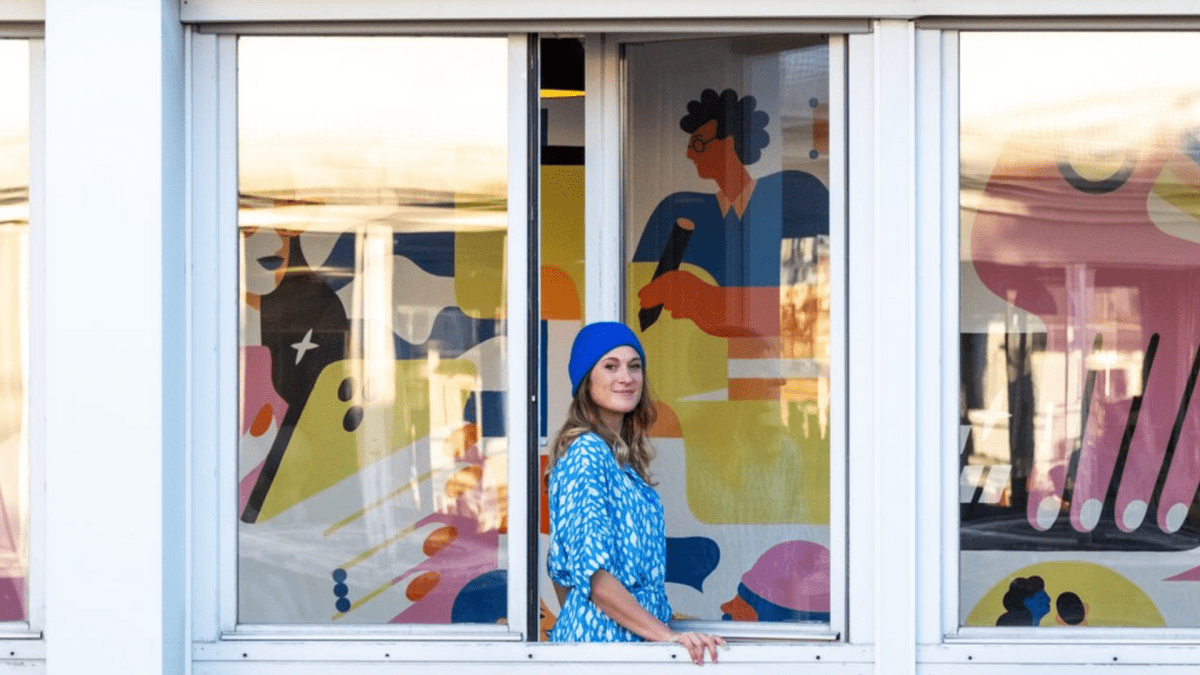
This is precisely the mission that drives Alix d'Anselme , whose luminous and expressive murals transform spaces as diverse as primary schools, the Palais de la Femme, and the Necker Hospital. Through her work, she makes each wall an invitation to escape and contemplation, making art accessible to all.
In this interview, Alix offers us a sincere and inspiring perspective on her artistic approach. She talks about the impact of art on society, the realities of her work as a muralist, and the importance of artistic practices in our daily lives.
-
You started your career as a graphic designer. What led you to move towards muralism, a rather significant change?
After studying at an art school in Paris, I began my career as a graphic designer creating visual identities for small and medium-sized businesses. Illustration quickly became a natural extension of my work, bringing a personal touch to my projects.
In 2020, during lockdown, I questioned many aspects of my life, particularly my professional routine. Life behind a screen no longer satisfied me; I wanted to do something with my hands.
In October of the same year, a friend in Barcelona asked me to paint the doors of his offices, located in the Gracia district, where I was living at the time.
I obviously jumped at the chance, and this project marked a real turning point in my career: I wanted to make it my profession.
I thought it was a logical continuation of what I was already doing; all I had to do was change the medium, replacing the screen or sketchbook with a wall!

2) Could you tell us about your love for color, the shapes you use, and the inspirations that fuel your work?
It's quite obvious when you look at my work: I love color! A large part of my drawings draws its inspiration from my life experiences. I lived for five years in Spanish-speaking countries (Argentina and Spain), where color is omnipresent, whether in the street or inside houses.
Humans also inspire me greatly, in their actions and expressions, which is why my illustrations are often figurative and expressive, with characters or animals in action.
3) You incorporate a participatory aspect into your projects. How do you involve students and residents in the creation of your collective murals?
The participatory aspect of my projects is something I particularly appreciate. After seven years of freelancing and working alone from home, I sorely missed human interaction. Becoming a muralist has allowed me to reconnect with that, and I try to share the painting experience on almost every project.
I therefore organized several workshops open to children and adults. Beyond the fun aspect, these workshops allow participants to take ownership of the space and become fully involved in the project. In schools, for example, collaborative murals leave a strong impression on students: they are proud and happy to contribute to a work that will become part of their daily lives.
4) In a world where digital technology is playing an increasingly important role, why do you think it is essential to preserve and encourage manual artistic practices, both among children and adults?
I am convinced that hands-on activities are essential for developing creativity in all its forms. Recently, during a workshop, a teenager confided in me: "It clears my head; it's so much better than studying for my baccalaureate. But I didn't know that painting walls could be a real job!" His genuine interest in painting touched me deeply. Creative professions are still too often neglected in school curricula, even though they deserve to be valued more highly.
Children, in particular, are always enthusiastic about participating in creative workshops. I'm convinced that these experiences stimulate their imagination far more than hours spent in front of a screen. Adults, on the other hand, often hesitate to get started, for fear of not knowing how or due to a lack of experience. Yet, once I have a paintbrush in hand, I've never had a negative response. The reactions are almost always the same: " I can't think of anything else , I love it," "I didn't think I was capable of it," or even "It makes me want to repaint my son's room!"
In September 2023, I organized a workshop with young people with motor disabilities. Despite their difficulties controlling their movements, they took immense pleasure in painting and expressing themselves freely.
That's the magic of creative activities: they offer a space for freedom, relaxation and achievement accessible to all.

5) Art sometimes sparks debate and controversy, as was the case with certain sequences from the opening ceremony of the Paris 2024 Olympic Games. Do you think that art must always provoke a reaction, or can it also simply be a source of joy and wonder?
It's a very interesting topic, and there's a lot to say about it. For me, art is first and foremost the freedom to express whatever you want, on any subject. The artist's message must achieve its goal by evoking an emotion, whatever it may be. However, when an artist is commissioned by a client, as is the case for me, they often face constraints related to the commission. I have to respect certain rules and, above all, satisfy my client. Therefore, I don't consider myself a completely free artist, like a painter who sells canvases in a studio, for example.
I think my art is rather "gentle," reflecting my personality. I'm not very confrontational by nature, and above all, I want to convey joy and "buena onda," as they say in Spanish, through my projects.
On the other hand, I find it admirable that some artists use art to advocate for causes, challenge conventions, or convey messages to society.
6) The life of an artist, and particularly that of a muralist, can seem very inspiring and full of freedom. However, what, in your opinion, are the less visible realities of this profession, and what advice would you give to someone who dreams of following this path?
I love my life as a muralist, and I'm happy to get up every day to work. It's a true passion. However, as with many professions, there are constraints associated with this lifestyle.
The first is the physical intensity. I sometimes work for several weeks without a day off on large projects, which puts my body under considerable strain. The working conditions are often similar to those of construction workers: being immersed in dust, carrying heavy loads of paint, climbing up and down scaffolding, working weekends or sometimes nights. Fortunately, not all projects are so grueling, but it remains an aspect to consider if you want to become a muralist.
The second constraint concerns the management of self-employment. Finding clients, managing a project from A to Z, invoicing and taking care of a significant part of the accounting, while balancing one's schedule to find moments of rest, can sometimes be a real challenge.
Finally, you have to be prepared to travel, because projects aren't always concentrated in the same neighborhood or city. You have to be willing to spend several days away from home and see it as an opportunity to discover new places. Personally, I love this aspect, but it's not for everyone.
7) Finally, if you could create a mural on any building or monument, which one would you choose and why?
I have so many dreams in mind that it's difficult to choose. In three years, the projects I've completed have far exceeded my expectations, and I like this idea of leaving room for surprise and trusting fate for the future.
If I had to answer that question, I would say that I would love to work on more projects in the restaurant industry. A restaurant is a place for sharing, a break in the day, a time for reconnecting, laughter, and meeting new people, where the atmosphere is essential. I would like to work on both the identity and the overall feel of the place, perhaps even collaborating with architectural firms. I also have many other projects in mind, such as coworking spaces, concert venues, bars, and cafés… All these shared spaces inspire me enormously.
I also want to continue working on community projects, even if it doesn't always cover my expenses. My goal is to share art where it's most needed. For example, I'm currently looking to paint a mural in a retirement home, which would be a wonderful opportunity to bring some joy to a place that desperately needs it.