

What games should be chosen to help understand the concept of consent and develop empathy?
How can we talk about consent, respect, and emotions without creating discomfort or embarrassment?
This is one of the major challenges faced by teachers, educators, and parents when addressing these essential topics with children and teenagers. And yet, these discussions are crucial for building a more just, respectful, and caring society.
That's where the game comes in.
A powerful educational tool , it allows for addressing complex themes such as consent and empathy in a concrete, participatory, and positive way. Through play, young people can experiment, put themselves in someone else's shoes, reflect on their reactions, and understand, without judgment, what it truly means to "respect others."
With the implementation of the new EVARS (Education in Affective, Relational and Sexual Life) program , schools and educational structures are now encouraged to use playful tools to promote dialogue and mutual understanding.
But which games should be chosen to accurately convey these values? Which formats work best depending on age? And how can they be used effectively so that the message truly gets through?
In this article, discover how games can become true allies in education about consent and the development of empathy — and our advice on choosing the ones best suited to your needs.
Why use games to address consent?
A universal and accessible language
The game speaks to everyone, regardless of age, education level, or social background. It's a universal language that transcends differences and puts all participants on an equal footing.
When it comes to addressing sensitive topics such as consent, this playful and supportive framework helps to defuse awkwardness and establish a climate of trust.
Through role-playing , young people grasp sometimes abstract concepts—such as personal boundaries, respect, and mutual agreement—in a concrete and engaging way. Playing is about experimenting: by acting, observing, and reacting, they naturally integrate what they learn.
Promote participation and engagement
Unlike a lecture, often perceived as top-down, the game places young people at the heart of the learning experience . They are no longer spectators, but participants.
Educational games transform theory into practice: saying “consent is essential” is not enough — young people must be allowed to experience situations where they learn to recognize, give or refuse it .
This interactive approach stimulates attention, promotes memorization, and encourages positive emotional involvement . The pleasure of playing becomes a powerful learning tool: we retain information better when we participate in the action.
Encourage the expression of emotions and the taking of perspective
Play is also a fantastic tool for emotional and relational development . Through play, children and teenagers learn to express their emotions, listen to those of others, and put themselves in their shoes.
This perspective is essential to understanding consent: it helps to recognize verbal and non-verbal signals, to perceive the discomfort or agreement of the other person, and to adjust one's own behavior.
Educational games about consent thus develop key skills such as empathy, caring communication and mutual respect — solid foundations for building healthy and balanced relationships, at any age.
Understanding the needs according to age and target audiences
Addressing consent and empathy isn't the same for 8-year-olds, 13-year-olds, or 17-year-olds. Educational games allow you to naturally adapt the language level, the depth of the discussions, and the complexity of the situations to suit different audiences. Here's how to approach them step by step.
Primary school: laying the foundations gently
In primary school, the main goal is to lay the foundations of respect and listening .
Children discover the concepts of personal boundaries, agreement and disagreement through simple, cooperative and positive games.
The preferred supports are those that promote the recognition of emotions, such as the emotion memory game in TOPLA and respect for the body — without ever directly addressing sexuality.
The main challenge: learning to say “yes” and “no”, to listen to others and to recognize what we feel and what others feel.

Middle school: developing critical thinking and discussion
In middle school, students begin to explore more complex concepts: group influence, friendship, reputation, the beginning of romantic relationships…
Games are fantastic conversation starters here . They encourage young people to analyze situations, argue, nuance and compare their opinions in a supportive environment.
Role-playing games or participatory quizzes allow us to identify with different points of view and to reflect on the impact of each behavior.
=> The objective: to strengthen the ability to think for oneself, to say no to social pressure and to express one's limits.
High school and beyond: deepening understanding of concepts and debates
Among high school students and young adults, discussions can go further.
Games then become a tool for collective reflection on relationships, mutual respect and the “grey areas” of consent : ambiguous situations, group pressure, influence of social networks…
These activities encourage reasoned speech , constructive debate , and the deconstruction of stereotypes .
The game here becomes a space for exchange where everyone can question their perceptions and develop genuine empathy for others.
Summary table: the benefits of gambling according to age
|
Age range |
Main objectives |
Recommended game types |
Skills developed |
|
Primary school (7–10 years old) |
Discovering emotions, understanding respect, learning to say no |
Cooperative games, emotional card games, charades, choose-your-own-adventure stories e.g.: Topla's Emotions Memo |
Listening, respecting the body, expressing emotions |
|
Middle school (ages 11–14) |
Developing critical thinking and discussion |
Role-playing games, interactive quizzes, situational games |
Reflection, empathy, confidence, verbal expression |
|
High school (ages 15–18) |
To explore the concepts of consent and healthy relationships in greater depth Developing tolerance |
Debate games, educational board games about respect and communication |
Argumentation, perspective-taking, emotional autonomy |
|
Young adults (18 years and older) |
Strengthening relational bonds and a sense of mutual respect |
Collaborative games, participatory workshops, simulations |
Relational ethics, dialogue, responsibility |
The different types of games to prioritize
Not all games have the same impact when it comes to addressing consent and developing empathy. Depending on the educational objectives and context (school workshop, group activity, prevention session, etc.), some formats are better suited to discussion, others to role-playing or group reflection. Here is an overview of the most effective types of games.
Role-playing games and simulations
Role-playing games allow you to step into someone else's shoes and experience different points of view .
It is a powerful method for making people feel rather than simply explaining : the experience of playing the game provokes a real awakening of awareness.
Examples of activities:
-
Can YOU? by Topla: Each player draws a character card and steps into their shoes for the duration of the game. The characters are all different in terms of gender, skin color, abilities, sexual orientation...

Debate or discussion card games
Discussion games encourage personal expression and the friendly exchange of ideas.
Each card, question or situation triggers a discussion on themes such as respect, emotions, relationships or non-violent communication.
Examples:
-
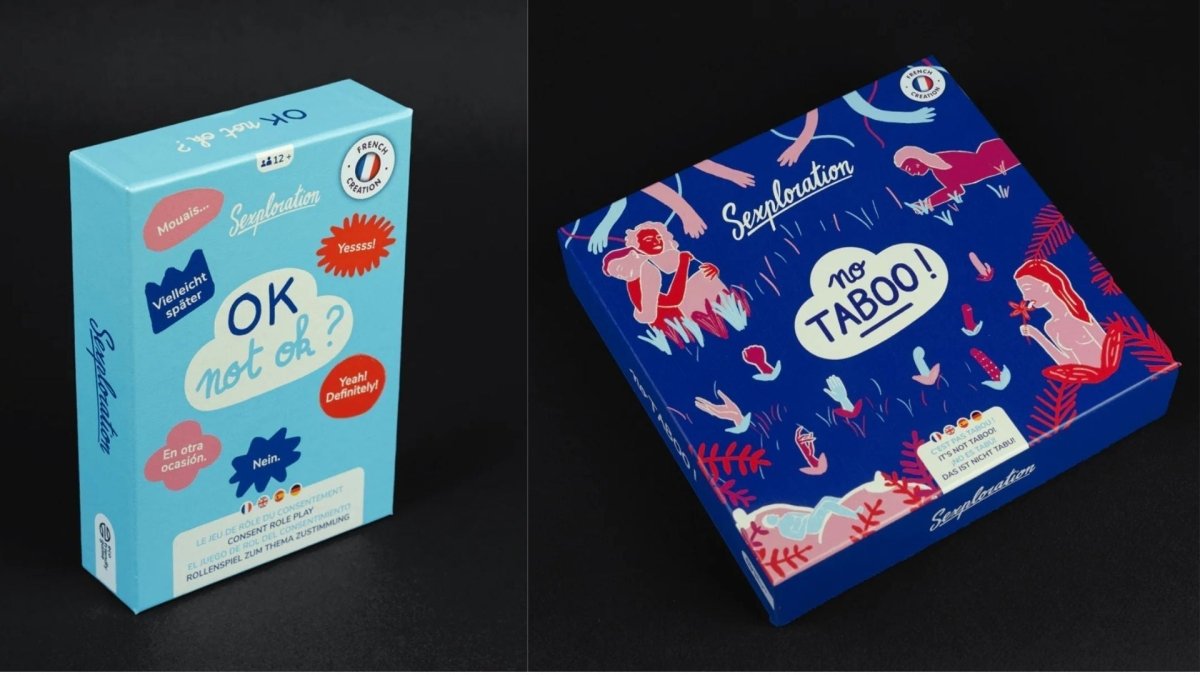
Card games about emotions and consent (e.g., OK Not OK , No Taboo , Can You?, Totem, ages 8 and up)
Ideal for: developing argumentation skills , stimulating collective thinking and strengthening active listening among young people.
Cooperative games
Unlike competitive games, cooperative games place participants on the same side: they win or lose together .
This type of game promotes solidarity, listening, and collective decision-making .
Players learn to express themselves without dominating and to listen without judging, which is an essential basis for consent and empathy.
Examples:
-
Collaborative board games where everyone brings their skills to solve a puzzle or to resolve a conflict between children: Idéo- La Table Ronde, No Way Bully!
-
Team games with common objectives that promote communication and respect for roles.
Ideal for: working on empathy indirectly , in a climate of trust and cooperation.
Creative or artistic games
Creative games liberate speech in a different way: through drawing, imagination, storytelling or staging.
They allow us to talk about sensitive subjects without being confrontational and to express emotions that are sometimes difficult to verbalize.
Examples:
-
Collective creation of mini-scenarios around respect or friendship.
-
Drawing games or participatory storytelling where everyone illustrates an emotion or situation.
Ideal for: encouraging free expression , stimulating creativity and fostering a caring environment where everyone feels heard.
Practical tips for leading a session on consent
Facilitating a workshop on consent using games requires a clear framework, preparation, and a caring attitude.
The game is not just a learning tool: it is a space for expression and collective reflection where each participant must feel free and respected.
Here are some essential tips to ensure successful, safe and educationally enriching sessions.
Prepare a safe environment
Before starting the game, take a few minutes to establish the rules for living together .
They form the basis of any discussion about consent:
-
Mutual respect: everyone has the right to express themselves without being mocked or judged.
-
Confidentiality: what is said during the session does not go beyond the agreed-upon framework.
-
Right to silence: no one is obligated to speak about their personal experience. It can even be risky in certain cases, such as school bullying. It is important to state that if anyone needs or wants to talk about a personal experience, whether they witnessed it or are involved in it, they can meet with a specific person after the session (name them, provide a location, and a time).
-
Kindness: we listen to understand, not to contradict.
Tip: Writing these rules on a visible board or poster allows you to refer back to them at any time during the workshop.
A safe environment gives participants confidence and creates the conditions for sincere, respectful and constructive exchanges.
Adapt the speech and the presentation to the group
The same game will not be perceived in the same way by a group of 5th graders, middle school students, or high school students.
That's why it's essential to adapt your posture and words to the audience:
-
For younger children: prioritize concrete examples, emotions, and respect for the body and speech.
-
For middle school students: encourage discussion, role-playing and collective reflection.
-
For high school students: addressing grey areas (social pressure, romantic relationships, digital intimacy) with tools that encourage nuance.
The facilitator plays a role of facilitator : he does not give “the right answer”, but helps to formulate, listen and reformulate .
He ensures that everyone can participate, without forcing those who prefer to observe.
Always remember that there is no “good” or “bad” emotion: understanding is already learning.
Debriefing systematically after the game
The debriefing is a key step in transforming the playful experience into lasting learning .
This is the moment when players become aware of what they have experienced, felt, and learned.
Some points for discussion:
-
What did you feel during the game?
-
What surprised you or made you think?
-
Are there situations that resemble real life?
-
Which attitudes do you consider the most respectful?
This time for discussion allows emotional learning to be anchored , certain misunderstandings to be addressed, and concrete solutions to be explored.
It can be enriched by reading a resource document , a teaching sheet or a follow-up activity .
Tip: always end on a positive note, an emotion, an idea to close the game in a spirit of respect and empathy.
Making games lasting allies for a culture of respect
The use of educational games in consent and empathy education is not a passing fad; it is a genuine pedagogical tool. By helping young people experience, debate, and feel rather than simply listen to instructions, games enable:
-
to develop listening skills, the expression of emotions and respect for boundaries;
-
actively engaging participants reinforces the memorization and appropriation of values;
-
to build a culture of relational well-being and kindness that goes beyond the classroom.
Because they complement traditional teachings—such as those introduced within the new EVARS (Education in Affective, Relational, and Sexual Life) program— educational games are not a substitute but a strategic tool. They create a relaxed, participatory, and safe space for discussion, where everyone can engage at their own pace and with authenticity.
Are you a teacher, facilitator, educator, or parent? Don't miss the opportunity to equip your institution, association, or home with engaging tools adapted to education on consent and the development of empathy. Explore our collection of educational games designed to promote respect, discussion, and cooperation on TOPLA and transform every session into a lasting moment of awareness.
Together, let's make games true allies in building a culture of respect, here and now.

Leave a comment
This site is protected by hCaptcha and the hCaptcha Privacy Policy and Terms of Service apply.