

Learning to identify one's emotions and boundaries: games to support the emotional education of teenagers
During adolescence , reference points shift. Giving young people concrete tools to recognize their emotions , set boundaries , and respect those of others profoundly changes the group dynamic. Topla's educational games allow these sensitive topics to be addressed in a fun, structured, and supportive way, encouraging expression, listening, cooperation, and empathy.
Why work on emotions and boundaries during adolescence?
- Getting to know yourself better allows you to make decisions that are aligned with your needs and values.
- Prevent risky situations by knowing how to say yes, no, or "I need time".
- Improve the group climate through listening, cooperation and calm exchanges.
- Boost self-esteem by learning to clearly express feelings.
Educational principles that guide Topla games
- Learning by doing : manipulating, playing, debating, testing concrete solutions.
- A supportive environment : rules of emotional safety, right to pass, non-judgment.
- Co-construction : we compare viewpoints, we reformulate, we search together.
- Transfer to everyday life : each part ends with tips to apply in real life.
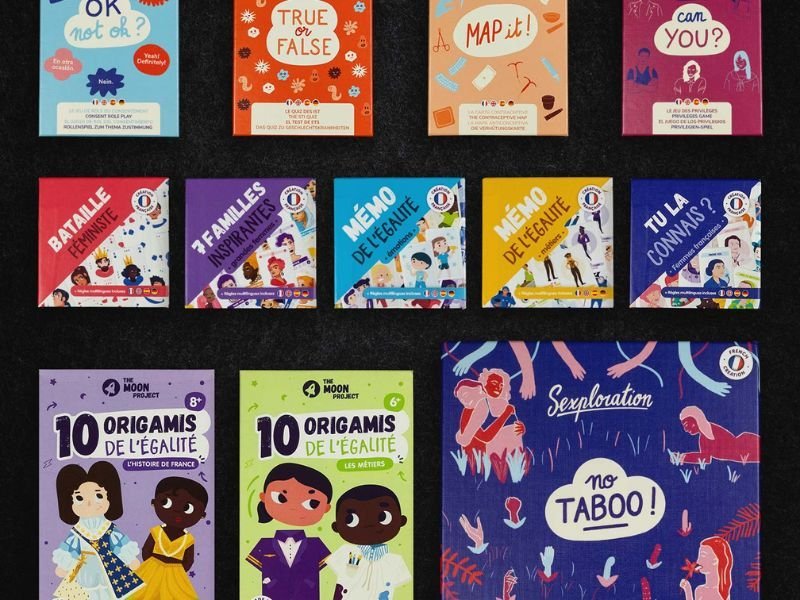
Topla games for affective and emotional education
No Way, Bully!: Understanding bullying and knowing how to react

Designed to analyze realistic situations of harassment and peer pressure, this game invites teenagers to choose helpful responses and discuss their consequences. It develops the ability to regain control in a bully/victim relationship, to find inner resources to resist, all within the safe environment of a board game.
- Skills used : listening, argumentation, cooperation, conflict management.
- Objectives : to recognize a problematic situation, to seek solutions, to propose effective non-violent responses
Equality Memo – Emotions: Enriching Emotional Vocabulary

A simple yet powerful tool for precisely naming what one feels. By developing a nuanced vocabulary, teenagers gain clarity of expression and emotional regulation , necessary conditions for setting respectful boundaries.
- Skills used : body recognition of emotions, empathy, reformulation.
- Objectives : to move from "it's okay / it's not okay" to precise and actionable feelings.
- Memo Emotions offers gender-neutral visuals where girls and boys can feel the same emotions. Ages 4 and up
5 families of fun activities for emotions and boundaries
1. Cards of emotions and associated needs
Objective: to enrich emotional language and link emotions , needs , and small actions . Teenagers choose an emotion, describe a possible situation, suggest an associated need, and then a small, realistic step to feel better.
2. Limit Thermometer
Objective: to help everyone determine their comfort level. Scenarios are placed on a spectrum ranging from "completely OK" to "not OK." Each player explains their level and can move it after discussion, which legitimizes "no" and shows that boundaries evolve.
3. Scenario box and responsible choices
Objective: to practice decision-making. A scene from everyday life is chosen, along with several possible responses. The group discusses the consequences, selects an option, and then proposes a respectful alternative if necessary.
4. Structured Role-Playing Games
Objective: to put into practice clear expression , listening and respect for consent . "Role" and "objective" cards guide short scenes, followed by a debriefing: what helped, what was a problem, what will be tried next time.
5. Cooperation and repair
Objective: to learn how to repair the damage after a mishap and to revive cooperation. "Repair actions" cards help to formulate effective apologies and propose concrete actions.
A simple grid for naming emotions, needs, and limits.
| I notice | I feel | I need | My limit | I propose |
|---|---|---|---|---|
| A specific fact, without judgment | A nuanced emotion | A clear need | Yes, No, Not now | A concrete and respectful action |
This matrix structures speech, facilitates self-regulation and applies to all activities.
Activity tips for a safe environment
- Starting rules : respect, confidentiality, right of way, attention to vocabulary.
- Gradual approach : start with light topics and then move on to sensitive subjects.
- Systematic debriefing : what I learned, what I keep, what I try during the week.
- Inclusivity : welcoming the diversity of experiences and remembering that every limit is legitimate.
- Transfer : note a real-life situation where the skill being practiced can be used.
Example of a four-session learning path
- Session 1 : emotion cards and vocabulary, mini identification challenges.
- Session 2 : thermometer of limits, expression of consent and disagreement.
- Session 3 : Responsible scenarios and choices, consequences and alternatives.
- Session 4 : Role-playing, repair and action plan for daily life.


Leave a comment
This site is protected by hCaptcha and the hCaptcha Privacy Policy and Terms of Service apply.