
What is an inclusive game? Understanding, choosing, and playing differently
In a world striving for social justice and equal opportunities, inclusion has become a major issue, including in the world of gaming. But what does "inclusive gaming" really mean? Is it simply a game accessible to everyone, or is it a socially engaged educational tool?
At Topla , we develop games designed to be inclusive, thought-provoking, and bring people together. Here's a clear and expert guide to understanding what an inclusive game is, and why it should be in every game library, whether for families, schools, or businesses.
Definition of an inclusive game
An inclusive game is a game designed to be accessible, representative, and respectful of the diversity of players. It aims to:
- Remove barriers related to gender, origin, physical or mental abilities
- Promoting equality, tolerance and respect
- To represent individuals fairly in rules, content, or characters
In other words, an inclusive game excludes no one : neither through its mechanics, nor through its language, nor through the messages it conveys.
What are the characteristics of an inclusive game?
1. Neutral and accessible language
- No sexist or racial stereotypes
- Use of vocabulary appropriate for the target age group
- Inclusion of non-gendered people, without exclusionary language
2. Visual and narrative representation
- Characters of diverse genders, origins, and abilities
- Topics addressing social issues (equality, harassment, etc.)
- Scenarios that avoid clichés and open up discussion
3. Physical and cognitive accessibility
- Simple or adaptable rules
- Clear, ergonomic, high-contrast design
Why offer inclusive games to children (and adults)?
Inclusion cannot be decreed: it is built from childhood.
Inclusive games allow for:
- Developing empathy, tolerance and cooperation
- Combating prejudice from a young age
- To give each player the opportunity to recognize themselves
Among adults, they also open up spaces for dialogue on sensitive topics (sexism, consent, diversity, etc.).
Topla: a concrete and committed approach to inclusive play
At Topla , inclusion is at the heart of our mission. Since 2014, we have been developing games for:
- Learning to recognize stereotypes
- Promoting gender equality
- Talking about consent, diversity, and living together
Examples of inclusive games by Topla:
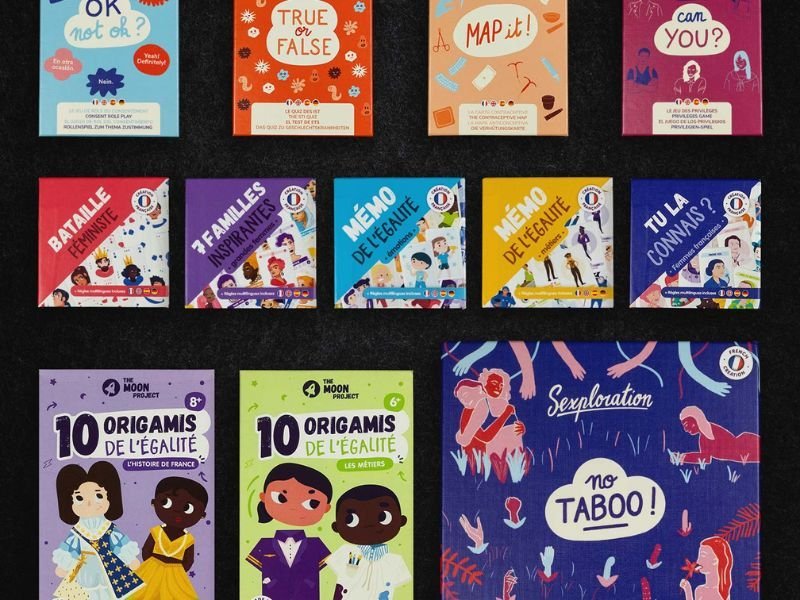
The 5 games in the Sexploration collection:
- OK or not OK?
A card game for teens aged 12 and up about consent, emotions, and personal boundaries. Each situation is discussed with "Yes, No, Maybe" answers to encourage open and respectful dialogue.
- True or False
A question and answer game about STIs.
- MAP it!
A fun tool about contraception for teenagers
- Can you?
A game of relational challenges to explore the concepts of consent, interaction, and respect for others. Encourages cooperation and listening.
- no taboos!
A discussion game to encourage open discussion on often taboo subjects (sex, body, emotions…), without judgment, in a supportive atmosphere.
Other inclusive games:
A twisted version of the classic battle game
- 7 Inspiring Families
A game of 7 families where each family represents a field of activity (science, sport, art, etc.). The characters embody diversity and equality.
- Equality Memo (x2 versions)
Two educational memory games about:
- emotions,
- Job stereotypes
- 10 Origami of Equality – The History of France
A hands-on, educational activity that introduces important women from history through folding and reading.
- 10 Origami of Equality – The Professions
Same concept as the previous one, but this time focused on traditionally gendered professions, with a message of deconstructing roles.
Summary table: how to recognize an inclusive game
| Criteria | Presence in Topla games |
|---|---|
| Diverse characters | Yes, in 7 Inspiring Families, Summer 1960 |
| Stereotypes | Yes, in OK not OK?, no TABOO! |
| LGBTQIA+ Inclusion | Yes, with MAP it and open roles |
| Cognitive accessibility | Yes, legible material, simple rules |
| Non-sexist language | Yes, in all Topla ranges |
An educational tool for teachers and professionals
Many educational institutions use Topla games as teaching aids in:
- Workshops on equality, emotions, or consent
- Training courses for facilitators and teachers
- Community and social programs
Conclusion: a truly inclusive game is an educational act

A game is not just entertainment. It is a vehicle for culture, representation, and social learning.
Choosing an inclusive game means choosing to:
- Make room for each player
- Encourage dialogue on key issues
- Contributing to a more tolerant and just society
At Topla, it's our daily commitment . Playing to change the world, one laugh at a time, one different perspective at a time.
To learn more about the challenges of inclusive education, consult the resources of UNESCO , which offers clear and accessible guidelines for everyone.


Leave a comment
This site is protected by hCaptcha and the hCaptcha Privacy Policy and Terms of Service apply.