

Article: Educational games: definition, objectives, and tips for choosing the right one
Educational games: definition, objectives, and tips for choosing the right one
Learning through play: an idea that appeals to both teachers and business professionals. While educational games are often associated with childhood, their use extends far beyond the school setting. Whether for transmitting knowledge, developing skills, or facilitating memorization, educational games are proving to be powerful learning tools. But what exactly is an educational game? What are its objectives, its various forms, and why does it work so well? That's what we're going to explore together.
Understanding what an educational game is
1. A combination of play and learning
An educational game is a fun activity designed to impart knowledge, develop skills, or reinforce behaviors . It combines game mechanics (rules, challenges, enjoyment, interaction) with clear learning objectives. Unlike purely recreational games, educational games have an educational purpose from their inception.
Its effectiveness is based on a simple but powerful principle: we learn better when we're having fun. The player is active, involved, focused… without feeling like they're studying in the traditional sense.
2. Clearly identified educational objectives
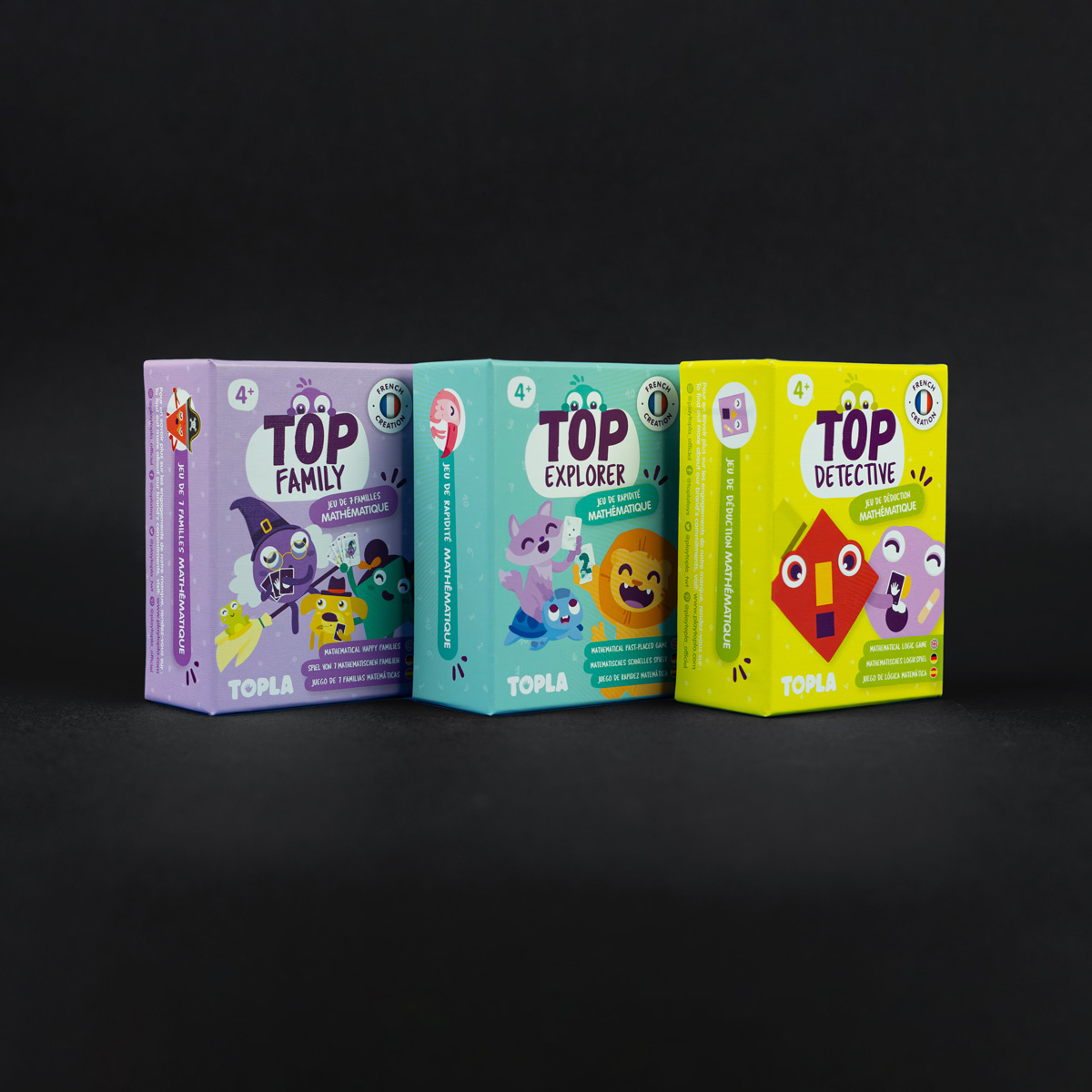
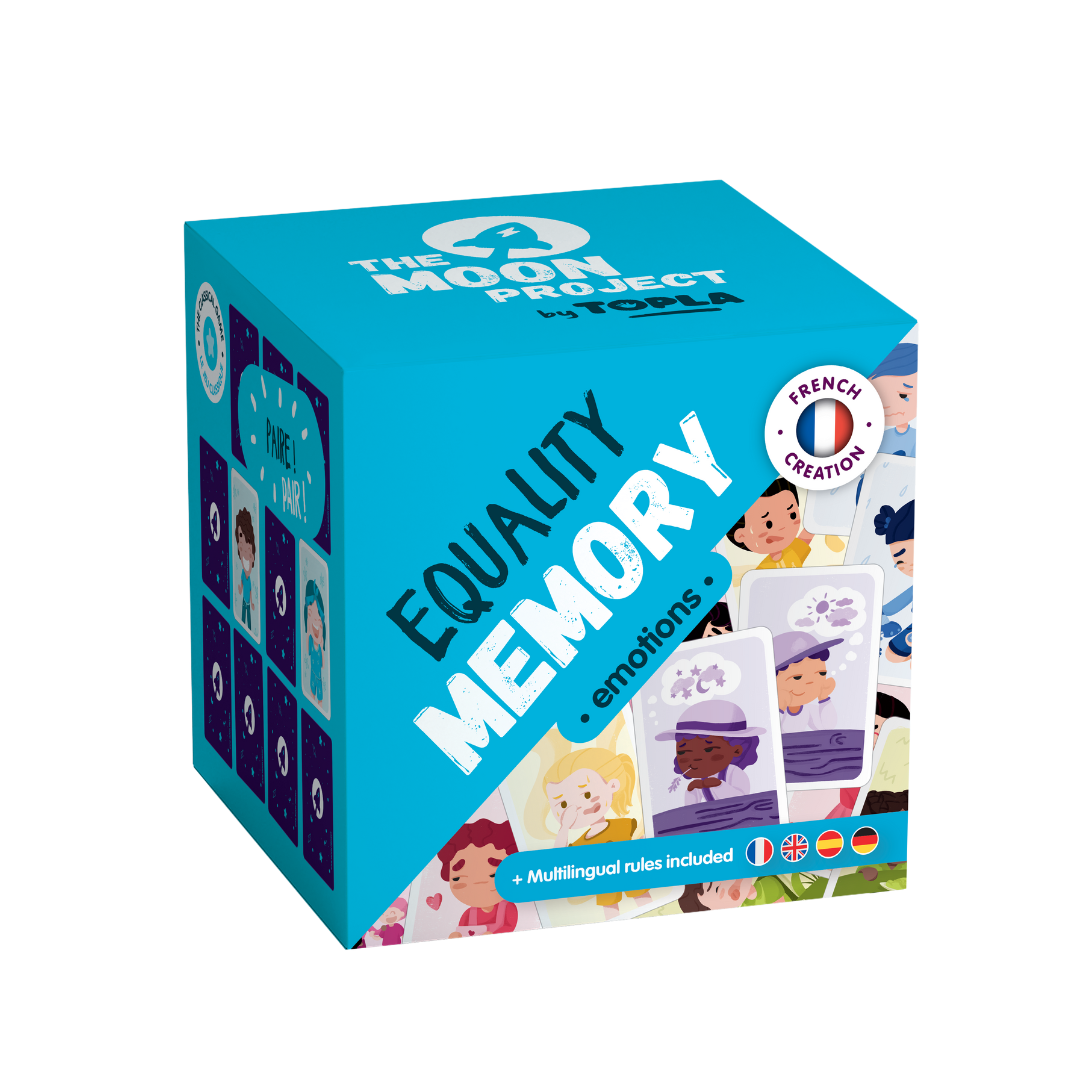
Educational games are not just about entertainment: they pursue a specific goal. This can involve acquiring knowledge (such as historical facts or mathematical concepts like the TOP' Explorer from Topla on the different representations of numbers), developing skills (logic, collaboration, communication…), or promoting attitudes (empathy, critical thinking, managing emotions like the Mémo Emotions …).
For example, a children's board game can teach fractions, while an adult role-playing game can train for negotiation in a professional context.
3. A distinction between educational games and pedagogical games
These two terms are sometimes used interchangeably, but they refer to slightly different realities.
-
The general aim of an educational game is to teach something, but in a more indirect or implicit way. It may not follow a rigorous pedagogical progression.
-
An educational game , on the other hand, is integrated into a teaching or training approach. It is often part of a structured program or learning path, with measurable objectives.
In summary: all educational games are educational, but not all educational games are pedagogical.
Why use games as a learning tool?
1. Cognitive and emotional benefits
The game stimulates numerous brain functions: attention, memory, creativity, logic … It also fosters self-confidence, stress management, and the joy of learning. By engaging both emotion and reason, the game activates powerful mechanisms for lasting memorization.
Studies show that learning that takes place in a playful context is often better retained and reused.
2. Active learner engagement
In a game, you're not passive. The player makes decisions, tests strategies, adapts… They become an active participant in their learning. This level of involvement is far greater than in a lecture or a traditional worksheet.
This commitment is particularly useful with audiences that are difficult to motivate, whether they are reluctant children, disengaged teenagers or adults who are not very receptive to traditional training.
Role-playing games where you put yourself in someone else's shoes allow for maximum engagement, such as:
-
Can You : A role-playing game for teenagers to develop empathy
-
OK not OK : A role-playing game about consent for teenagers

3. Learning without pressure: the role of intrinsic motivation
The game creates a safe environment where mistakes are part of the process. You can start over, try a different approach, and progress at your own pace. This strengthens intrinsic motivation —the kind that comes from a personal desire to learn, without external pressure.
This form of motivation is one of the most powerful drivers of sustainable learning, far more effective than simple reward or fear of failure.
The different types of educational games
|
Target audience |
Educational objectives |
Benefits / Specific Features |
|
Children (3–10 years old) |
- Discover basic concepts (math, language, science) - Develop fine motor skills, attention, and memory Example: Careers Memo - Learning social rules (taking turns, cooperation) |
Learning through experimentation A sensory, repetitive and accessible game Development of socialization and autonomy |
|
Adolescents (11–17 years old) |
- To deepen academic knowledge - To stimulate critical thinking, logic, and creativity - Developing social skills (listening, debate, leadership) |
Increased motivation through challenge and competition Role-playing games, escape games, and highly effective collaborative games Promotes the building of identity and confidence |
|
Adults (18 years and over) |
- Acquire or strengthen professional skills (communication, management, negotiation, etc.) - Facilitate continuing education (professional skills, safety, management) - Encourage team cohesion or a change in attitude |
Use of serious games and simulation games Active and contextualized learning It triggers introspection, strengthens cohesion and commitment. |
How to choose a good educational game?
Faced with the multitude of so-called "educational" games on the market, making the right choice isn't always easy. Whether you're a parent, teacher, or trainer, here are the essential criteria to consider when selecting a truly effective educational game.
1. Verify the clarity of the learning objectives
A good educational game isn't just fun; it must serve a clear learning objective. Always ask yourself:
-
What is the child, student, or participant supposed to learn by playing it?
-
Are these learning activities appropriate for his age or level?
Examples of objectives: recognizing shapes, developing vocabulary, learning to resolve conflicts, memorizing data, practicing public speaking…
Examples of math games:
-
Top Family on geometric shapes
-
Top Detective on Logic and Deduction
-
Top Explorer on numbers
2. Adapt the game to the target audience
A game that's suitable for 6-year-olds won't necessarily be suitable for teenagers, and vice versa. Adapting the game is crucial.
-
depending on the player's age and cognitive level ,
-
to his interests (themes, aesthetics, type of challenge),
-
to their specific needs (e.g. ADHD, dyspraxia, social difficulties...).
Tip: choose games that offer variations or progressive levels of use.
3. Observe the balance between fun and educational content
A game that's too "academic" risks becoming tedious. Conversely, a game too focused on fun may miss its educational objective. The right balance:
-
engaging game mechanics ( cooperation, challenges, storytelling, chance...),
-
Educational content integrated naturally , without forcing learning.
The player must learn almost without realizing it .
4. Prioritize replayability and autonomy
A good educational game is one that people want to play again:
-
It offers several different or evolving parts .
-
It allows the player to progress at their own pace , or even to play without the constant intervention of an adult.
The more replayable a game is, the more it anchors learning in the long term.
5. Test before you buy (if possible)
When possible, try out the game: at a library, in a specialty store, or via instructional videos. This will allow you to verify:
-
if it generates enthusiasm among the target audience,
-
if it is easy to use,
-
if it meets your educational expectations
The serious game: an educational game for adults
Serious games are games specifically designed for training, awareness-raising, or skills development, using the conventions of video games or simulations. Widely used in businesses, they allow for addressing complex topics (cybersecurity, crisis management, communication, diversity, etc.) in an engaging and interactive way.
They are aimed at adults in training, managers, or employees, and transform learning into an immersive experience. The participant is placed in a concrete situation, must make decisions, and observes the consequences.
Their main advantage? Combining immersion, emotion, and memorization in a risk-free environment. The result: you learn better, faster, and you retain information longer.
Limitations and precautions to be aware of
However powerful they may be, educational games are not miracle solutions. Their effectiveness depends on many factors, and certain precautions are essential for them to truly serve learning objectives.
-
The game does not replace supervision
Even the best-designed educational game requires a clear framework and often appropriate facilitation . Without guidance, learning can be overlooked or misinterpreted. The role of the adult (teacher, trainer, parent) is crucial in guiding, explaining, and debriefing.
-
Not all games are relevant
Some games are simply "dressed up" as educational, without any real educational content. Others may be too complicated, too long, or unsuitable for the target audience. It is therefore essential to test, compare, and above all, remain critical of marketing promises.
-
Risk of demotivation if misused
A poorly chosen or poorly introduced game can generate frustration , disinterest , or even exclusion (if some don't understand the rules or feel comfortable playing). It's essential to ensure the game is accessible , easy to understand , and that everyone has a fair chance to participate within the group.
-
Beware of the gimmick effect
Educational games should not be used simply to "pass the time" or "lighten the mood." If they are not integrated into a well-thought-out learning strategy , they risk losing their meaning and impact.
In summary, games are a powerful but demanding tool . Used wisely, they enrich learning. Used incorrectly, they can quickly become counterproductive.
FAQ – Everything you need to know about educational games
What is an educational game?
An educational game is a game designed to impart knowledge, develop a skill, or facilitate learning while having fun. It can be used at school, at home, in training programs, or in the workplace.
From what age can an educational game be used?
Educational games exist for children as young as 2 or 3, particularly for learning colors, shapes, or language. But they are also effective for teenagers and adults, especially through serious games or simulation games.
For example, the Emotions memo for ages 4 and up
What is the difference between an educational game and a serious game?
An educational game is often designed for children and focuses on fundamental learning (reading, logic, vocabulary, etc.). A serious game, on the other hand, is aimed more at adults or teenagers and simulates complex situations for training purposes (e.g., crisis management, communication, cybersecurity, etc.).
Can an educational game replace a lesson?
No, educational games are a complementary tool . They reinforce learning, make certain concepts more concrete and promote motivation, but they do not replace structured teaching.
How can we tell if an educational game is effective?
A good educational game should have a clear objective , be adapted to the target audience , offer genuine educational value , and encourage players to replay it. It is also essential to observe how participants react to it (engagement, progress, autonomy, etc.).
Where can I find good educational games?
You can find them:
-
in bookstores specializing in education ,
-
on dedicated websites like Didacto
-
in some media libraries ,
-
or via selections of games certified by educational organizations.


Leave a comment
This site is protected by hCaptcha and the hCaptcha Privacy Policy and Terms of Service apply.