

Games adapted for ADHD: supporting attention, emotions and confidence at any age
ADHD (Attention Deficit Hyperactivity Disorder) affects millions of children, teenagers, and adults. In everyday life, it can make certain situations more difficult: concentrating, following instructions, channeling energy, or managing emotions. However, play is a fantastic tool for addressing these challenges in a supportive way. It helps strengthen attention, develop self-confidence, and offer precious moments of relaxation. In this article, you will discover how to choose the most suitable games for ADHD, whether for a young child, a teenager, or an adult.
Understanding the specific needs of a child, teen or adult with ADHD.
Before selecting a game, it is essential to fully understand the specific characteristics of ADHD at each stage of life.
1. Difficulties with attention and organization
People with ADHD tend to get easily distracted. They struggle to filter out distractions and stay focused on a single task. This can make games that are too long or too complex discouraging, especially if they have to wait their turn or follow very rigid rules.
2. Frequent impulsivity and restlessness
Impulsivity is characterized by spontaneous reactions, often without considering the consequences. In children, this can mean interrupting others, touching everything, or flitting from one game to another. In adolescents or adults, it can manifest as impatience, hasty decision-making, or a constant need for stimulation.
3. A need for immediate recognition and gratification
To stay motivated, a child or teenager with ADHD needs quick, positive feedback. Games that offer frequent encouragement, visible rewards, or small, progressive successes are therefore particularly effective.
4. The importance of a reassuring and structured environment
A predictable framework helps reduce anxiety and improve concentration. Whether it's a board game, a physical activity, or an educational video game, it's helpful to provide clear rules, a calm environment, and well-defined steps.
By understanding these needs, we can better select suitable games that not only entertain, but also promote the development of essential skills at all ages.
Criteria for choosing a game suitable for ADHD
Choosing a game for a child, teenager, or adult with ADHD isn't just about looking at the recommended age on the box. Certain key criteria can help promote attention, reduce frustration, and maximize enjoyment.
A short duration and simple rules
People with ADHD get discouraged easily by instructions that are too long or complicated. It's better to choose games that are easy to understand, that can be played in a few minutes or in short sessions. This prevents loss of attention and frustration.
Example: games with quick turns (like Catorcat or Uno ) are often more engaging than 2-hour games.

Immediate interest and sensory stimulation
The game must captivate from the start: bright colours like in the game Summer 1960 , fun sounds, tactile elements… All these sensory aspects maintain attention and make the experience more motivating.
Tip: Choose visual and interactive games rather than purely verbal activities.

Quick and rewarding feedback
To stay motivated, a child or teenager with ADHD needs almost immediate positive feedback. Games that offer frequent rewards (points, badges, praise) boost self-esteem and the desire to persevere.
Example: educational applications that display visible progress after each exercise.
Flexibility and adaptability
Some days, attention spans are better than others. Choosing games with adjustable settings allows you to adapt the difficulty or duration to suit your energy level. It's also important to be able to easily pause and resume the game.
Example: free construction games (Lego, Kapla) or individual puzzles are more flexible than games with a mandatory beginning and end.
Keeping these criteria in mind, you will be able to select games that not only provide fun, but also offer real support for developing attention, planning, and emotional regulation skills.
Examples of recommended games and their benefits according to age
|
Game type |
Concrete examples |
Main benefits |
For whom? |
|
Construction and manipulation games |
Lego, Kapla, SmartMax |
- Develop fine motor skills - Promotes prolonged concentration - They allow the channeling of physical energy |
Child / Teenager / Adult |
|
Card games |
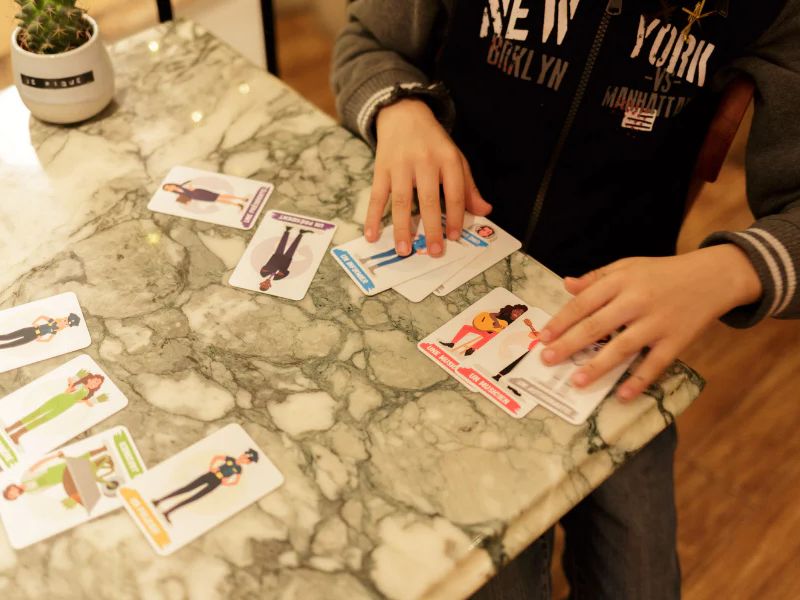
Uno, Dobble, Double Face , Jungle Speed, 6 Nimmt! |
- They learn to follow simple rules - They enhance visual attention and memory - They practice quick reaction times and emotional management |
Child / Teenager / Adult |
|
Short board games |
Dixit, Time's Up!, Concept, The Adventurers of the Rail Express, Top Family |
- Encourage social interaction and communication - Promote planning - Offer quick positive feedback |
Child / Teenager / Adult |
|
Cooperative games |
Bandido, Zombie Kidz Evolution |
- Reduce the pressure of competition - They strengthen team spirit - Helps manage impulsivity |
Child / Teenager |
|
Sensory and tactile games |
Stress balls, modeling clay, Pop It |
- Help to regulate motor restlessness - Soothes during periods of stress or sensory overload |
Child / Teenager / Adult |
|
Games of skill and gross motor skills |
Twister, Molkky, bowling |
- Allow you to expend physical energy - Improve coordination - They offer a fun and structured environment |
Child / Teenager / Adult |
|
Role-playing and imagination games |
- Stimulate creativity - They encourage the expression of emotions - They help to structure mental scenarios |
Child Teens and Adults |

Some additional tips
-
Adapt the level of complexity and duration according to age and attention level.
-
Vary the formats : quiet games, active games, creative games.
-
Prioritize cooperation to boost self-esteem and limit frustration.
-
Always value progress, even small progress, and respect the person's pace.
Cooperative and communication games
Cooperative games are a fantastic resource for supporting children, teenagers, and adults with ADHD. By playing together against the game itself, rather than against each other, the pressure of competition disappears, giving way to an atmosphere of mutual support and encouragement. These playful experiences foster self-confidence, the development of social skills, and the learning of active listening.
1. Why cooperation is beneficial for ADHD
Cooperation in the game offers several major advantages:
-
Frustration reduction : Children with ADHD often struggle with individual failure. Winning or losing together reduces pressure and feelings of guilt.
-
Strengthening social skills : Cooperating teaches you to express your ideas, to wait your turn and to accept the opinions of others.
-
Improved attention : Collaborative play encourages players to stay focused in order to follow the collective action plan.
-
Valuing everyone : Even the most discreet find their place and can make a contribution.
These advantages are equally important for teenagers and adults, who find in them a fun way to strengthen their relational skills in a caring environment.
2 Examples of collaborative games
Here are some cooperative games that are particularly suitable:
-
The Orchard (Haba)
Suitable for ages 3 and up, this game invites players to collect the fruit before the crow arrives. Simple and colorful, it's ideal for introducing young children to cooperation. -
Bandido (Helvetiq)
This simple card game is suitable for children aged 6 and up, as well as teenagers. Together, you must block the tunnels dug by the bandit trying to escape. The rules are easy and the games are quick. -
Magic Maze (Sit Down!)
For older children, Magic Maze offers the opportunity to silently guide characters through a shopping mall. The constraint of not speaking stimulates observation and non-verbal coordination. -
SOS Dino (Loki)
A cooperative family game where everyone helps dinosaurs escape the volcanic eruption.
These examples show that there are cooperative games for all ages, from very young children to adults.
Creative activities to do together
Cooperation is not limited to board games: manual and creative activities can also strengthen the ability to collaborate.
Some ideas:
-
Build a large model or puzzle where everyone has a specific role.
-
Invent a story with multiple voices and stage it with figurines.
-
To create a joint artistic project , such as a mural or a comic strip.
-
Organize a cooperative treasure hunt , which calls upon logic, memory and collective planning.
These shared moments help people with ADHD develop patience, confidence and enjoyment of being part of a group, while also stimulating their creativity.
Games to promote calmness and emotional management
Some games and activities are specifically designed to help children, teenagers, and adults with ADHD regain calm and better manage their emotions.
1- Sensory and relaxation games
Pleasant-to-the-touch materials, such as magic sand , modeling clay , or stress balls , provide soothing sensory stimulation. These tools can help reduce restlessness and refocus attention.
2- Breathing exercises and meditation
Simple tools, such as breathing cards , guided meditation apps or heart coherence exercises , can help you learn to relax and regulate your stress.
3- Interactive stories and quiet games before bedtime
Finally, audio stories , stories to invent together and calm games, such as puzzles or mandalas, are ideal for establishing a serene routine and facilitating sleep.
4- Games to express and recognize emotions, such as the Topla Emotions Memo
These gentle moments of play perfectly complement more dynamic activities and contribute to a better emotional balance on a daily basis.
Practical tips for integrating these games into your daily life
Scheduling regular playtime is essential to fully reap the benefits. Here are a few simple tips to help you do just that:
-
How to establish gaming rituals
Schedule fixed times (for example, after homework or before dinner) to create a reassuring routine. Rituals provide structure and make it easier for children to get on board.
-
Adapt the environment to limit distractions
Create a quiet, tidy space with minimal visual or auditory distractions. Remove screens and keep only the necessary gaming equipment within easy reach.
-
Encouraging without overstimulating: finding the right balance
Value every effort and small successes, without pressure or excessive excitement. Alternate dynamic activities and quiet times to respect each person's pace and attention span.
These good practices promote calm and enriching playtimes, whether with family, at school or during educational sessions.
Conclusion
Games adapted for ADHD are much more than just entertainment: they provide real support in daily life. By strengthening concentration, self-confidence, emotional management, and social skills, these activities contribute to a more serene and balanced development.
Don't hesitate to try different toys and see what works best for your child, teenager, or even yourself if you're an adult. Every child is unique, and sometimes you need to experiment with several types of toys before finding the ones that truly make a difference. You can check out specialized websites, like Hoptoys , which offer a variety of toys.
It is important to remember that teenagers and adults also derive great benefits from these playful moments, both to recharge their batteries and to strengthen certain skills.
%20affects%20millions%20of%20children,%20teenagers,%20and%20adults.%20In%20everyday%20life,%20it%20can%20make%20certain%20situations%20more%20difficult:%20concentrating,%20following%20instru...)