
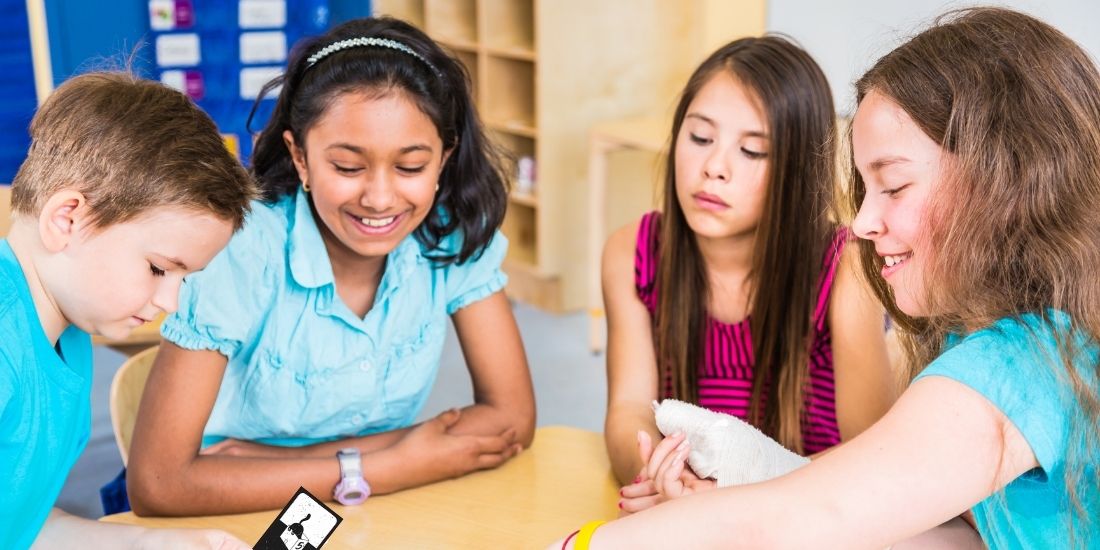
What are the 4 fundamental learning skills that the game develops?
Play is often perceived as a recreational activity, a simple moment of relaxation. Yet, researchers in education and psychology agree that it is a powerful tool for learning. From a very young age, playing allows children to discover the world, to experiment, to make mistakes, and to progress. But the benefits don't stop in childhood: play also supports adolescents and adults in developing essential skills.
Indeed, through its various forms – symbolic games, board games, role-playing games, educational games , or cooperative games – it helps shape knowledge and skills that serve us throughout our lives. UNESCO has also highlighted four main educational pillars: learning to think, learning to act, learning to live together, and learning to be .
In this article, we will explore how play concretely fosters these four fundamental learnings and why it should occupy a central place in educational practices, both at home and at school.
Learning to think: imagination, creativity and problem-solving
Games are a fantastic testing ground for intellectual exploration. Through play, children and teenagers develop their curiosity, their problem-solving skills, and their critical thinking. Each game becomes an opportunity to test ideas, develop strategies, challenge hypotheses, and learn to bounce back from setbacks.
By manipulating objects, inventing, or imagining scenarios, children learn to structure their thinking and develop creativity that will be useful far beyond the realm of play. This learning is not limited to childhood: at any age, play helps keep the mind sharp, trains memory, and stimulates the imagination.
Examples of games that stimulate thinking, according to age
|
Age range |
Examples of games |
Cognitive and creative benefits |
|
3-6 years |
Construction games (Lego, Kapla), simple puzzles, symbolic games (play kitchen, figurines), memory games ( Ze Bestioles , an artistic memory game of fantastic animals) |
They develop logic, fine motor skills, and creativity through imagination. |
|
6-10 years old |
Visual puzzle games (Dobble, Cortex), simple brain teasers, card games with clear rules (Uno, Mistigri), simple tactical games (Catorcat, Summer 1960 ) |
They learn concentration, observation, memorization, and basic strategies |
|
10-14 years old |
Investigation games (Cluedo, Detective Club), escape games, accessible strategy games (Carcassonne, Dixit) |
They develop logical reasoning, planning, and the ability to deduce. |
|
14-18 years old |
More complex strategy games (Risk, Catan), improvisation and creativity games (Concept, Imagine,From Ice to Penguins ) |
They strengthen critical thinking, decision-making, and originality of ideas. |
|
18 years and older |
Demanding cooperative games (Pandemic, Unlock!), management and strategy games (Terraforming Mars, chess, go) |
They stimulate strategic thinking, resource management, creativity and long-term thinking |

Learning to take action: autonomy, initiative and decision-making
The game isn't just about thinking; it also encourages action . Each game is a space where you make decisions, try out strategies, act, and observe the consequences of your choices. It's an ideal training ground for developing autonomy and self-confidence.
From a very young age, children learn to make simple choices (placing a piece, choosing a card) and then to take on more complex decisions (managing resources, anticipating the actions of others). These experiences help them strengthen their sense of initiative and understand that every action has an effect, a cause, a reaction.
The game is also a fantastic school of perseverance: losing, trying again, changing one's strategy… all valuable skills in everyday life, at school, or at work. In this sense, it perfectly embodies the principle of "learning by doing," widely recognized in active learning.
|
|
|
|||
|
Matching and sorting games, first cooperative board games (Little Cooperation, My First Orchard) |
Make simple choices, follow steps, develop autonomy |
|||
|
Board games (Game of the Goose, Monopoly Junior), beginner strategy games (Kingdomino) |
Deciding on actions, learning to manage the consequences, testing different approaches |
|||
|
Management games (Ticket to Ride, Splendor), narrative games with multiple choices |
Develop planning, initiative, and measured risk-taking |
|||
|
Advanced strategy games (7 Wonders, Small World), cooperative investigation games |
Anticipating, developing complex strategies, making collective decisions |
|||
|
Simulation, project management or role-playing games (Diplomacy, economic management games) |
Strengthening strategic decision-making, accountability, and adaptability |
Through play, children – and later adolescents or adults – learn to act intentionally . They discover that they have power over the course of the game, which strengthens their sense of competence and confidence in their own choices.
Learning to live together: cooperation, rules and communication
Through play, younger children discover essential values for living well in society: respect for rules, cooperation, empathy and communication.
Respect common rules
Each game is based on clear rules shared by everyone. By following them, children understand that to move forward together, it's necessary to respect a collective framework . This playful learning helps them grasp fundamental concepts like justice , sharing , and equality, such as the equality memory game about Topla's professions . These are all solid foundations for a harmonious social life, whether at school or in group activities.

Playing together: cooperation, negotiation and conflict management
Educational games put children in direct interaction. In collaborative games, they must join forces to achieve a common goal: cooperation becomes a key to success. In competitive games, they learn to negotiate , manage frustration, and resolve conflicts . These experiences allow children to concretely experience the social dynamics that punctuate everyday life.
Developing empathy and listening skills
Beyond the rules, the game teaches you to put yourself in others' shoes: waiting your turn, anticipating your partners' actions, and understanding the joy and disappointment of your opponents. This dimension develops active listening and empathy , essential skills for building positive relationships and developing genuine emotional intelligence.
For children, games about emotions are very useful for developing empathy from a young age.
For teenagers, many games exist such as
-
Can YOU? The inclusive game to develop empathy and tolerance
-
OK or not OK? The consent game

Board games and role-playing games: preferred mediums
Board games are essential for introducing children to concepts like patience, strategy, and mutual respect. They strengthen social bonds and teamwork. Role-playing games , on the other hand, immerse children in situations where they must embody a character, cooperate, and communicate to progress. These immersive experiences promote learning through play , offering a stimulating environment for developing autonomy and confidence.
Regularly incorporating educational board games or educational role-playing games into children's daily lives gives them the tools to live better together and grow up with confidence.
Learning to be: play as a tool for expression, managing emotions, and building identity
Play is not just a recreational activity; it is a valuable educational tool that allows children to better understand themselves, manage their emotions, and develop their identity. Through playful activities, they learn to express who they are , explore different facets of their personality, and enhance their daily well-being.
Discovering oneself through play: expressing one's tastes, talents and emotions
Play is first and foremost a space where children can express their creativity and assert their preferences. Whether they choose a role, a color, or a strategy, they reveal their personal tastes , develop their unique talents , and learn to put words to their emotions . These playful experiences foster self-confidence and allow them to better understand their strengths as well as their vulnerabilities.

excerpt from the Memo of Emotions game
Play as a safe space to test roles and build one's identity
Play provides a supportive environment where children can experiment with different roles without fear of judgment. By embodying a hero, an explorer, or an imaginary character, they feel free to explore a variety of behaviors and reflect on what truly resonates with them. This process of playful exploration contributes to the gradual development of their identity, helping them define themselves and find their place within the group.
How play also helps to regulate stress and enhance well-being
Beyond self-expression, play is also a powerful tool for managing emotions . It allows children to release tension, channel energy, and find strategies to alleviate stress . Laughter, interaction, and concentration promote the release of endorphins, the feel-good hormones. Thus, play is not limited to cognitive learning: it becomes a valuable resource for a child's emotional health and overall well-being.
Incorporating educational games focused on expression and emotions helps children to better understand themselves, accept themselves, and grow up with serenity. Because learning to be is just as essential as learning to read, write, or count.
Conclusion: Play, an educational pillar to be valued
Play is not simply a form of entertainment; it is an essential educational pillar that supports children in their fundamental learning. Through play, they learn to think (curiosity, logic, creativity), to live together (cooperation, rules, communication), to be (self-expression, emotional management, identity), and to do (experimentation, action, motor skills). These four dimensions form the basis of balanced and harmonious development.
Valuing play means recognizing its educational role and giving it a real place in children's daily lives. Whether it's free play at home, educational games at school, or playful activities in educational settings, every experience is an opportunity for learning and growth.
Numerous studies confirm that play is a powerful educational tool. A study published in Frontiers in Education even proposes a clear framework for integrating play into schools to promote social and emotional learning ( see the full article ).
Finally, play is not just for childhood. Throughout life, it remains a valuable resource for learning in different ways , developing creativity, strengthening social bonds, and preserving well-being. Making play a priority means investing in a richer, more humane, and future-oriented education.


Leave a comment
This site is protected by hCaptcha and the hCaptcha Privacy Policy and Terms of Service apply.