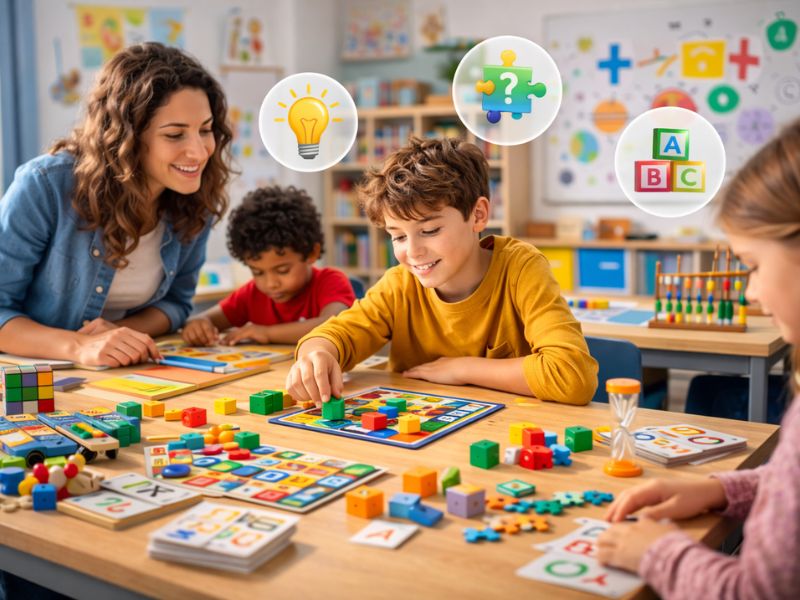
The playful mechanisms that stimulate concentration and attention
Concentration and attention are at the heart of any successful gaming experience. Yet, staying focused, engaged, and motivated isn't always easy, especially for children, teenagers, or adults whose cognitive functioning differs from the norm. This is particularly true for individuals with attention deficit hyperactivity disorder (ADHD), but also for many gamers who, without a specific diagnosis, may find it difficult to maintain their focus over time.
Board games offer a particularly interesting platform for developing these skills, provided their mechanics are well-designed . In the spirit of TOPLA, the aim is not to "force" attention, but to naturally elicit it through the pleasure of playing .

Concentration and attention: what are we really talking about?
Attention is not simply about “staying calm” or “concentrating for a long time”. It encompasses several dimensions:
-
the ability to focus on a task
-
the ability to filter out distractions
-
the ability to maintain effort over time
-
the ability to move from one piece of information to another without getting lost
In people with ADHD, these functions can be more fluctuating, with periods of hyperfocus and others of rapid disengagement. But these variations also exist in many gamers, regardless of their age.
A well-designed board game can then become a structuring tool , channeling attention without constraining it.
Why play is a natural lever for attention
The game captures attention because it combines several powerful factors:
-
a clear objective
-
intrinsic motivation
-
a defined framework
-
an immediate or progressive reward
Unlike schoolwork or work, play is based on desire. Engagement is voluntary , which profoundly changes the way the brain mobilizes its attentional resources.
But not all games stimulate attention in the same way. It all depends on the game mechanics used.
The mechanisms that actually promote concentration
Simple and consistent rules
Concentration drops quickly when players constantly have to check rules or deal with exceptions. Short, logical, and consistent rules free up mental space, allowing players to focus on what matters most: playing.
A clear framework is reassuring, especially for profiles that need structure, such as some people with ADHD.
Thus, simple games like card games, memory games, and logic games work very well.
Example :
- 7 inspiring families
- Memory Emotions
- Top Explorer
- Top Family

A goal that is legible at all times
Knowing what you have to do and why is fundamental. When the objective is unclear or changes without explanation, attention is scattered.
Games that implicitly or explicitly remind people of their goal at each turn promote continuous attention without excessive effort.
A regular rhythm
A pace that is too slow can lead to boredom, while a pace that is too fast can generate stress. Games that offer a smooth alternation between action, observation, and decision-making help maintain attention without overloading the player.
For people with ADHD, predictability of pace is often more important than speed itself.
Well-structured game turns
Turn-based combat is a powerful tool for concentration. It allows you to:
-
knowing when to act
-
knowing when to observe
-
anticipate without being constantly solicited
This temporal structure helps to stay engaged, even when it's not your turn to play.
Limited but significant choices
Too many choices can be paralyzing or tiring. Conversely, clear decisions, with a limited number of options, facilitate decision-making and maintain focus on the game situation.
This principle is particularly relevant for players who are easily distracted or who are afraid of "doing it wrong".
Quick feedback
Seeing the consequences of one's actions quickly strengthens commitment. Whether it's visible progress, a point gained, or a milestone reached, this immediate feedback fuels motivation and sustains attention.
Without feedback, attentional effort loses its meaning.
Attention and ADHD: what play can offer
In people with ADHD , attention often functions in a non-linear way. Play can then play an interesting role, provided certain principles are respected:
-
avoid excessively long periods of downtime
-
limit sources of distraction
-
to offer short and engaging sequences
-
to offer a clear structure without excessive rigidity
The game is not intended to “correct” ADHD, but it can become a space where attention naturally finds its expression , without judgment or pressure.
Games like Catorcat, Summer 1960 offer short durations of 15 minutes.

The importance of the game framework
The mechanics aren't everything. The context in which you play strongly influences concentration:
-
quiet environment
-
instructions clearly stated
-
right to make mistakes
-
possibility of taking a break
An accessible game is also a game that accepts variations in attention , without penalizing the player.
Games and concentration: an inclusive approach
Talking about concentration doesn't mean aiming for performance. In an inclusive approach, such as the one promoted by TOPLA, the objective is to:
-
to make the game accessible to a variety of profiles
-
respect individual rhythms
-
value commitment rather than speed
The game mechanics then become tools at the service of shared pleasure, and not constraints.
How to recognize a game that promotes attention
Without going into the details of specific games, certain indicators can help identifyeducational games that are more conducive to concentration:
-
rules that can be understood quickly
-
controlled duration
-
few unnecessary interruptions
-
clear interactions
-
modular atmosphere
These criteria are valid for all players, and even more so for those whose attention is more sensitive to distractions.
Conclusion

Concentration and attention are not fixed qualities. They depend on the context, motivation, and how an activity is structured. Board games, when based on well-designed mechanisms, can become a fantastic way to naturally and sustainably engage attention.
In the TOPLA universe, the challenge is not to create games “for” a specific audience, but to design accessible playful experiences , capable of adapting to varied profiles, including people affected by ADHD.
A good game doesn't demand perfect attention. It makes it possible.